- →Hand-run creator marketing is a 13-step treadmill that restarts every 1-2 weeks as creatives fatigue
- →49% of US consumers and 65% of Gen Z now use TikTok as a search engine, so whoever fills the feed gets discovered
- →The autopilot model runs the whole pipeline: keywords, briefs, creators, 30-90 brand-owned accounts, autoposting, dashboard, one-click boosting
- →Unit economics: 900+ posts and 1M+ views a month per brand at a $7.78 median cost per post, paying per verified view
- →Campaigns end and reset to zero; permanent presence in social search compounds
Creator marketing works. Running it by hand is where brands break.
Think about what one campaign actually takes: find creators, vet them, write briefs, contract, pay, chase links, track results. Then do it all again next week, because the creative already burned out. It's a full-time team's job, and most brands trying to grow an app don't have that team. So they run creator marketing badly, or not at all, and lose the feed to whoever shows up.
That's the gap the autopilot model closes. Here's exactly how, with the numbers that make it a different game.
The old way is a treadmill, and here's the math
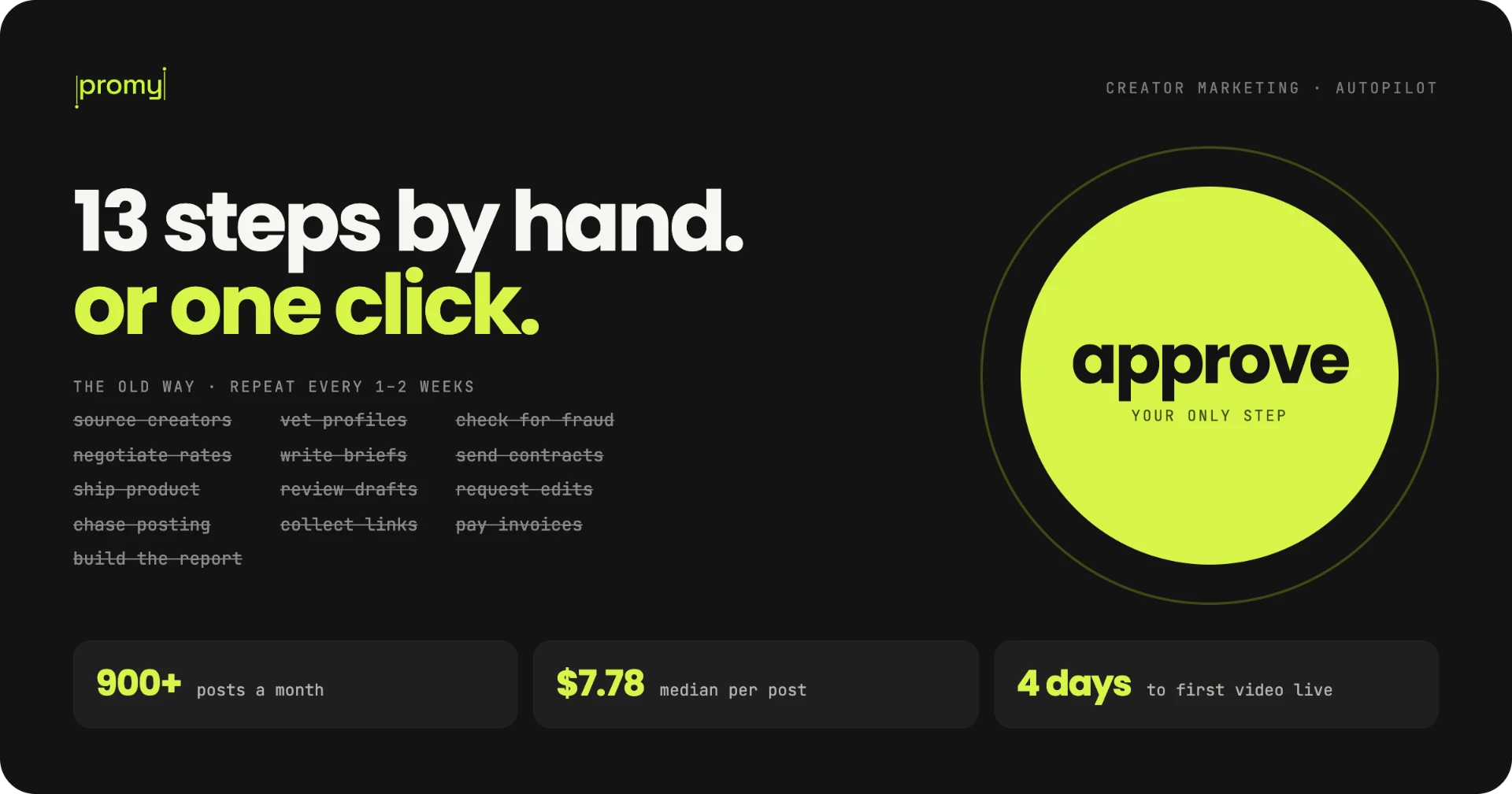
13 steps to run a single influencer program. Sourcing, vetting, briefing, contracting, paying, tracking, each one by hand.
Every 1-2 weeks you start over. TikTok creatives fatigue in days; an app needs 5-8 fresh videos per ad group, constantly, just to stop performance from decaying.
79% of marketers can't prove their influencer spend worked.
1 in 3 creator accounts show fraud signals, and on flat fees you pay for those views anyway.
Add it up: expensive, slow, unprovable, permanently on fire. The problem was never that creator marketing doesn't work. It's that running it by hand doesn't scale. Ever.
Meanwhile, search moved into the feed
While running campaigns stayed hard, the stakes exploded.
49% of US consumers now use TikTok as a search engine, up from 41% in 2024.
65% of Gen Z do the same.
People don't Google an app anymore. They search TikTok, Instagram and YouTube, or they ask an AI that pulls its answer straight from those videos. Which means one thing: whoever fills the feed for their keywords gets discovered. Everyone else is invisible.
And "filling the feed", enough fresh videos, across enough accounts, covering enough search terms, every single week, forever, is exactly the thing a human team physically cannot do. The most important job in marketing right now is the one hand-run creator marketing is worst at.
For one niche in numbers, see how often people search workouts in the fitness apps report.
The autopilot model: you approve, it runs
Here's the flip. Instead of a team grinding 13 steps on a treadmill, an AI system runs the entire pipeline. Your whole job is to click approve.
- Keywords. AI finds the winnable search queries in your niche.
- Briefs. It studies what's performing and writes fresh ones every week, so creative never goes stale.
- Creators. UGC creators matched to each brief.
- Accounts. Content ships across 30-90 brand-owned accounts, not one channel posting twice a week.
- Autopost. Videos publish automatically across TikTok, Instagram and YouTube, each with its own UTM link.
- Dashboard. Live views, clicks and performance, per video and per creator.
- Boost. Top videos pushed to Spark Ads and Meta ads in one click.
Paste your website. It detects your keywords. You approve the plan. First videos are live in 4 days.
The numbers that make it a different category
This isn't a faster version of the old thing. The unit economics are different.
900+ posts a month, per brand. Volume no in-house team or agency can touch.
1M+ views a month, per brand, compounding as the account network grows.
$7.78 median cost per post. Compare that to $150-$500+ for a single flat-fee creator video. Automation plus volume collapses what one post costs to make.
Pay per verified view. Every number is verified before you're billed. Fraud views count toward nothing. A video that flops costs you a fraction of one that lands. You buy results, not posts.
Campaigns end. Presence compounds.
Here's the real shift, and it's the whole point.
The old model thinks in campaigns: run one, it ends, the videos age out, start over. The autopilot model builds permanent presence in social search. Every video keeps answering queries long after it's posted, and because the network never stops posting, your coverage compounds instead of resetting to zero.
In a world where search lives in the feed and AI reads the feed to answer, the brands that win aren't running the best single campaign. They're simply always there, under every search term, across every platform, as a standing fact. By hand, that's impossible. On autopilot, it's just Tuesday.
Creator marketing was always going to work. The only question was whether you could run it without it running you. Now you don't have to.