- →TikTok traffic converts at 0.46-2.4%, friction after the click is what drops it lower
- →Message match between the video and the landing page is the highest-impact fix
- →Mobile load under 3 seconds, single column, thumb-sized CTAs, social proof in the hero
- →Switch TikTok Ads Manager to Landing Page View optimization, not Click
You ran a great campaign. The creator content hit 200K views. People watched, commented, saved, shared. Then you checked your landing page analytics and your stomach dropped: a conversion rate of 0.4%.
The instinct is to blame the traffic. "TikTok users don't convert." "They're just there to scroll." "It's a top-of-funnel platform."
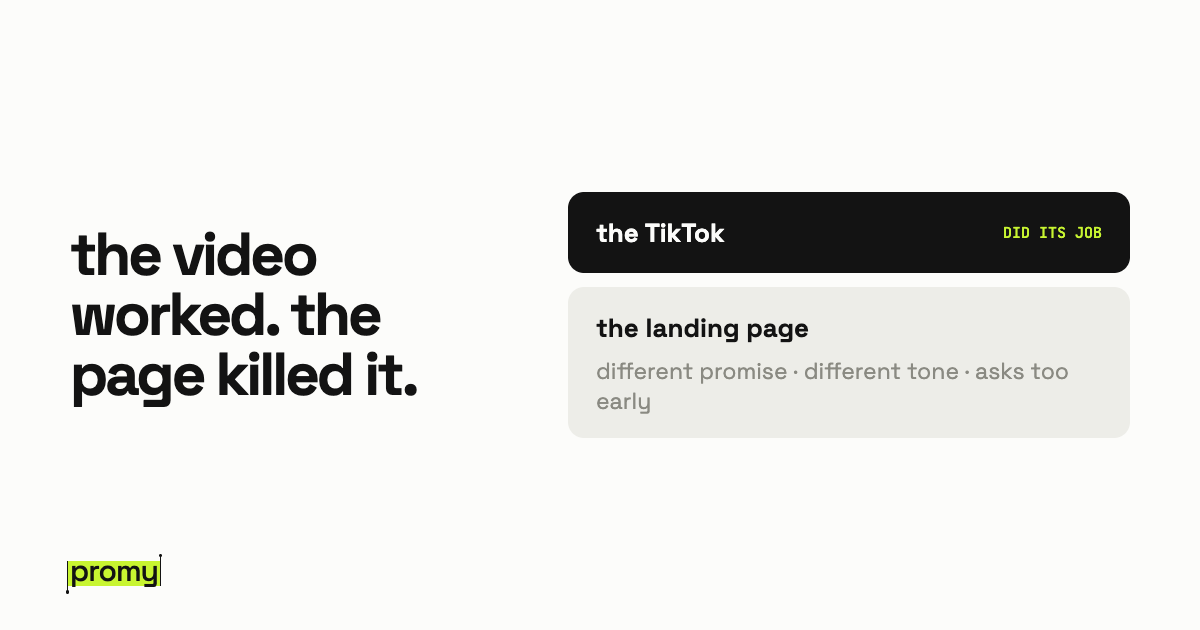
That's usually wrong. The traffic isn't the problem. The problem is the gap between the TikTok experience and what happens the moment someone lands on your page.
A TikTok user lives in a world of instant, vertical, mobile-first, visually-driven content with zero friction. Then they tap your link and arrive at a page built for a different universe: slow-loading, desktop-designed, text-heavy, with a headline that has nothing to do with the video they just watched. The disconnect is jarring, and they bounce in under 3 seconds.
Here's exactly why it happens and how to fix it.
The Numbers: What's Actually Normal
First, let's set expectations. TikTok traffic converts differently than other channels.
The average TikTok ad conversion rate for standard campaigns sits between 0.46% and 2.4%. With a well-optimized landing page, a strong offer, and a warm audience, e-commerce campaigns hit 1-3%. Lead generation (forms instead of purchases) runs higher at 3-5% because filling out a form is lower commitment than buying.
And when you remove the external landing page entirely by using TikTok Shop, conversion rates can exceed 10%, because there's almost no friction between the video and the purchase.
That last stat is the whole story in one number. The more friction between the content and the action, the lower your conversion rate. Your landing page is friction. The question is how much.
Reason 1: Message Mismatch
This is the single biggest conversion killer for social traffic.
When someone taps the link after watching a creator's video, they have a specific expectation in their head, set by that video. If your landing page doesn't immediately confirm that expectation, they feel like they're in the wrong place and they leave.
This is called message match, and it's the main reason brands have high-engagement content but low conversions.
The creator's video said "this $29 skincare serum cleared my skin in 3 weeks." The viewer taps through expecting to see that exact serum, that price, that promise. Instead they land on a generic homepage with 40 products, a "Welcome to our store" banner, and no mention of the thing they actually came for.
The fix: build a dedicated landing page that continues the exact promise from the content. If the creator featured a specific product, that product is the hero of the page. If the video mentioned a price or a promotion, that offer is visible immediately, above the fold. The headline on your page should echo the language from the campaign.
Never send influencer traffic to your homepage. Homepages are designed for people who already know your brand and are browsing. Influencer traffic is the opposite: strangers who came for one specific thing. Give them that thing immediately.
Reason 2: Your Page Is Too Slow
82.9% of landing page traffic comes from mobile, and TikTok traffic is essentially 100% mobile. Mobile users are impatient. They leave if your page takes more than 3 seconds to load.
Every second of load time erodes your conversion rate by approximately 7%. A page that takes 5 seconds to load instead of 2 is quietly killing a meaningful chunk of conversions before anyone even sees your offer.
The reason this happens: most landing pages are built on full catalog themes loaded with apps, tracking scripts, large uncompressed images, and heavy code. Every app and script adds load time.
The fix: compress all images (WebP format loads fastest). Remove tracking scripts and apps you're not actively using. Use a lightweight theme or a dedicated landing page builder instead of your full e-commerce catalog theme. Test your page on Google PageSpeed Insights and aim for under 3 seconds on mobile, ideally a score of 90+.
For Shopify users specifically: lightweight landing page builders almost always outperform full catalog themes for paid social traffic. The catalog theme is built for browsing. The landing page is built for converting.
Reason 3: It's Not Built for the Thumb
TikTok users aren't just mobile-first. They're mobile-only in mindset. They expect vertical, single-column, thumb-friendly experiences. Most landing pages are designed on a desktop, for a desktop, and then "made responsive" as an afterthought.
The signs your page is fighting mobile users: multi-column layouts that shrink awkwardly, text too small to read without zooming, buttons too tiny to tap accurately, forms with too many fields, and CTAs that sit below several scrolls of content.
The fix: design mobile-first, not desktop-first. A single vertical content flow. Large, tappable buttons (at least 44x44 pixels). Text large enough to read without zooming. Your primary CTA should appear above the fold and repeat further down the page. If you use a form, cut it to the absolute minimum number of fields. Every additional field reduces completion.
Think about how the page feels under a thumb, scrolling fast, one hand, possibly walking. That's your actual user.
Reason 4: No Social Proof Where It Counts
Most influencer traffic is cold. These are people who watched one video and tapped a link. They don't know your brand, and they're quick to judge. Social proof is what bridges the gap between curiosity and purchase.
The mistake most brands make: burying reviews, ratings, and testimonials halfway down the page or on a separate page entirely. By the time a skeptical visitor would reach them, they've already left.
The fix: put social proof in the hero section, not below it. Star ratings and review counts should be visible immediately. Prioritize specific, detailed reviews over generic ones. "It arrived in 2 days and my skin was visibly clearer within a week" converts better than "Great product, love it!"
Bonus: if the influencer who drove the traffic is credible, feature their content or a quote on the landing page. The viewer just watched that person. Seeing them again on your page creates continuity and reinforces trust at the exact moment doubt creeps in.
Reason 5: The TikTok Optimization Setting Nobody Changes
This one is technical but it matters enormously if you're running Spark Ads or any paid TikTok traffic to an external page.
Inside TikTok Ads Manager, if you're sending traffic to an external landing page, your optimization goal should be set to "Landing Page View," not "Click." This tells TikTok's algorithm to find users who are likely to actually stay on your page after tapping, not just users who click and immediately bounce.
In one study, Landing Page View optimization cut the cost per landing page session by 79.58% compared to standard link click optimization. Same budget, same creative, dramatically more people actually arriving and staying on the page. The difference was one setting.
If you're optimizing for clicks, TikTok finds you cheap clicks from people who tap reflexively and leave. If you optimize for landing page views, it finds people with genuine intent.
The Diagnostic: If Your Rate Is Below 1%, Check These in Order
When TikTok traffic converts under 1%, run through this checklist in sequence.
- →Message match. Does your page continue the exact promise from the content? If not, fix this first. It's the highest-impact change.
- →Load speed. Run PageSpeed Insights on mobile. Under 3 seconds? If not, compress images and cut scripts before doing anything else.
- →Mobile design. Open the page on your own phone. Is the CTA above the fold? Are buttons easy to tap? Is text readable? Fix the obvious friction.
- →Social proof placement. Are reviews and ratings visible in the hero section? Move them up if they're buried.
- →TikTok optimization setting. If running paid traffic, switch from click optimization to Landing Page View.
Most conversion problems are solved within these five. Notice that none of them are about the traffic quality. They're all about the post-click experience.
The Bigger Picture: Views Are Only Half the Job
Here's the uncomfortable truth that connects all of this: a brilliant influencer campaign with a broken landing page is wasted money. And a mediocre campaign with a perfectly optimized landing page can still convert.
The view is the first half of the job. The click-to-conversion experience is the second half. Brands obsess over the first half (which creators, which content, how many views) and neglect the second half (what happens after the tap). Then they blame the channel when the conversions don't materialize.
This is why thinking about your campaign as a full pipeline matters. The content gets the view. The landing page captures the intent. If either link is broken, the whole thing fails.
When you run performance-based influencer campaigns, you get something valuable for fixing this: data on which content drove the most engaged traffic. The videos with the highest save and share rates tend to send the most motivated visitors. Match your best-performing content to a purpose-built, fast, mobile-first, message-matched landing page, and the conversion gap closes fast.
The traffic was never the problem. It was always about what you did with it after the click.