- →TikTok's 10K threshold blocks its own programs, not brand deals
- →Performance-based campaigns pay on views, not follower count
- →UGC, TikTok Shop, direct outreach, and repurposing all work under 10K
- →Engagement rate and niche relevance matter more than account size
TikTok has a monetization wall, and it's not subtle about it.
The Creator Rewards Program requires 10,000 followers and 100,000 video views in the last 30 days. TikTok Shop affiliate needs at least 1,000 followers. LIVE gifts need 1,000. If you're sitting at 800, 2,000, or even 8,000 followers, TikTok's own programs aren't paying you anything.
Meanwhile, your content is getting views. Maybe 5K per video. Maybe 30K on a good day. People are engaging, commenting, saving. The content works. You're just below an arbitrary threshold that has nothing to do with the quality of what you're making.
Here's the thing most small creators don't realize: brands are actively looking for you. Not despite your small following, but because of it.
Why Brands Want Nano Creators in 2026
There's a shift happening in how brands spend influencer budgets, and it works directly in your favor.
40% of influencer marketing budgets now go specifically to micro and nano creators. That number has been climbing every year because the performance data keeps proving the same thing: smaller creators drive higher engagement per dollar than bigger ones.
The numbers across TikTok in 2026:
| Creator Tier | Followers | Avg. Engagement Rate |
|---|---|---|
| Nano | 1K-10K | 8-12% |
| Micro | 10K-100K | 5-8% |
| Mid-tier | 100K-500K | 3-5% |
| Macro | 500K+ | 1-2% |
If you have 3,000 followers and your videos consistently get 8-10% engagement, your content is outperforming creators with 200K followers on the metric that actually matters to brands. Engagement rate measures how much your audience cares, not how large it is.
Brands have started to understand this. The smart ones aren't looking for one creator with 500K followers anymore. They're looking for 30 creators with 3K-15K followers whose audiences actually pay attention.
The 5 Ways to Earn Under 10K Followers
1. Performance-based influencer campaigns
This is the biggest opportunity most small creators don't know about yet.
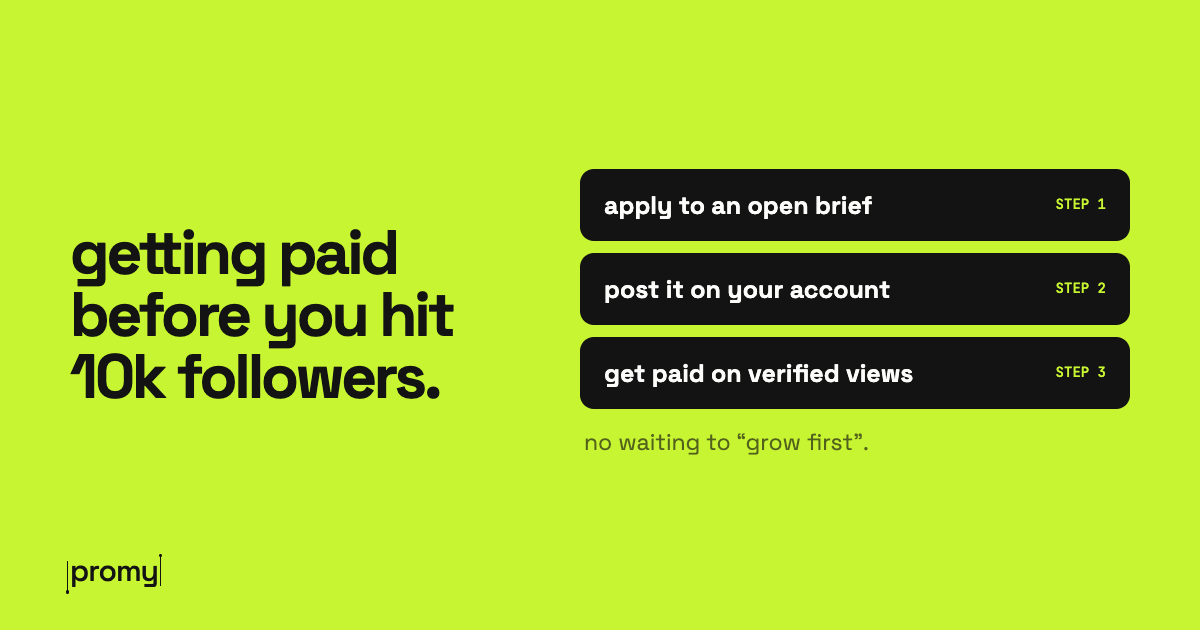
Performance-based campaigns work differently from traditional brand deals. Instead of negotiating a flat fee based on your follower count (which locks out small creators by default), brands set a campaign budget and open it to a pool of creators. You apply, get accepted, post your content, and earn based on how your video actually performs: views, likes, comments, saves, reposts.
The payout scales with results, not with your follower count. A creator with 3,800 followers whose video hits 147K views earns significantly more than a creator with 72K followers whose video gets 4,200 views. We've seen this happen repeatedly. The algorithm doesn't care how many followers you have. It cares whether people watch your video.
What this looks like in practice: a brand puts $5,000 into a campaign. 30-40 creators participate. A strong-performing video with 200K views, 10K likes, and 2,600+ saves earns roughly $1,250. Even a modest video with 15K-20K views earns $80-$150. You're getting paid for what your content delivers, and your follower count is irrelevant to the payout calculation.
The barrier to entry is your content quality, not your audience size. If you can make engaging TikTok videos that hold attention, you can earn from these campaigns regardless of whether you have 1,500 or 9,000 followers.
2. UGC (User-Generated Content) freelancing
UGC is when a brand pays you to create content that they post on their own account or use in their ads. You never post it on your profile. Your follower count literally doesn't matter because the content lives on their channel.
UGC rates for beginners typically range from $50-$150 per video. Experienced UGC creators charge $200-$500+ per video, and some specialize in specific niches (beauty, food, tech unboxing) where they command premium rates.
How to get started:
Build a UGC portfolio with 5-10 sample videos. These can be for fictional brands or products you already own. Film them in the style of native TikTok content (vertical, good lighting, natural delivery). Post your portfolio on a simple website or even a Google Drive folder.
Then reach out to small DTC brands that are running TikTok ads. If you see a brand running ads with creator-style content, they're already buying UGC. Send them a short pitch with your portfolio link. Or list yourself on UGC marketplaces like Billo, Insense, or JoinBrands where brands come to you.
The limitation: UGC is freelance work. You're trading time for money on a per-video basis, and the content doesn't build your own audience. It's a solid starting income stream, but it doesn't compound the way posting on your own account does.
3. TikTok Shop affiliate (1,000+ followers)
If you've crossed 1,000 followers, you can join TikTok Shop's affiliate program. You browse products, create content featuring them, and earn a commission on every sale generated through your video's product link.
Commission rates vary by product category but typically range from 10-30%. On a $30 product at 15% commission, every sale earns you $4.50. If your video drives 50 sales, that's $225 from a single video.
The advantage of TikTok Shop is that TikTok handles everything: payment processing, shipping, customer service. You just make the content. And because TikTok's algorithm actively pushes shopping content to interested buyers, even small creators can generate meaningful sales if the product fits their niche.
The catch: you need to genuinely like and use the products. Audiences can tell instantly when someone is pushing a product they've never touched. The best TikTok Shop creators treat it as honest recommendation, not as advertising.
4. Direct brand outreach (yes, even under 10K)
Most creators assume brands won't respond to them below 10K followers. That's true if you send a generic "I'd love to collaborate!" DM. It's not true if you send something specific and valuable.
The approach that works:
Find small brands (under 50 employees, under $10M revenue) in your niche that are already on TikTok but posting poorly. Check their account. If their content looks overly produced, gets low engagement, or feels nothing like native TikTok content, they need help.
Send them a short message (email is better than DM for professional outreach):
The key is the sample video. Don't ask for money upfront. Show them what you can do. A 30-second spec video costs you nothing but an hour of time, and it demonstrates your value better than any media kit.
Small brands are more open to working with nano creators because they can't afford mid-tier rates. A $150-$300 deal with a small brand is a great starting point, and if the content performs well, it becomes an ongoing relationship.
5. Cross-platform content repurposing
Your TikTok content can earn money on other platforms simultaneously. Instagram Reels, YouTube Shorts, and Pinterest Idea Pins all distribute short-form video content, and each has its own monetization thresholds and brand deal ecosystems.
YouTube Shorts now pays creators through the YouTube Partner Program (requires 1,000 subscribers and either 10M Shorts views in 90 days or 4,000 watch hours on long-form). Instagram has bonuses and brand partnership tools. Pinterest drives traffic to affiliate links and blogs.
The effort is minimal because the content already exists. You're just uploading the same vertical video to additional platforms with slight adjustments (removing TikTok watermarks, adjusting captions for platform norms).
This isn't a primary income source for most small creators, but it compounds over time as you build audiences across platforms.
What Brands Actually Look at (It's Not Follower Count)
When brands evaluate whether to work with a creator, here's what matters and what doesn't.
Matters
- →Engagement rate. Are people interacting with your content relative to your view count? 5%+ engagement on TikTok is solid. 8%+ is excellent.
- →Content quality and style. Does your content feel native to TikTok? Is the hook strong? Do people watch past the first 3 seconds? Can you hold attention for 15-30 seconds?
- →Niche relevance. If a skincare brand is looking for creators, they want someone whose content is already in the beauty/skincare space. A creator with 2,000 followers who posts skincare routines daily is more valuable than a creator with 50K followers who posts random content.
- →Comment quality. Are your comments real conversations? "Where did you get that?" and "Can you do a tutorial?" indicate an engaged audience. "Nice! 🔥" from the same 15 accounts indicates engagement pods.
Doesn't matter (as much as you think)
- →Follower count. Seriously. In performance-based campaigns, follower count has almost no correlation with video performance. TikTok's algorithm distributes content based on quality and retention, not account size.
- →Posting frequency. Brands care about the quality of your last 10 videos, not whether you post twice a day.
- →Verification status. A blue check doesn't affect your content's performance or your value to brands.
How to Build a Profile That Attracts Paid Opportunities
A few practical things you can do this week to position yourself for brand work.
- →Write a bio that signals you're open to partnerships. Something simple: "Collabs: [your email]" or "For brands: [email]." This is the universal signal that you're open for business. Without it, brands can't reach you even if they want to.
- →Pin your 3 best-performing videos. When a brand clicks your profile, the first thing they see should be your strongest work. Pin videos that demonstrate range, personality, and strong retention. Not your highest view count, but your most engaging content.
- →Keep your content niche-consistent. If you post skincare one day, gaming the next, and cooking the day after, brands can't categorize you. Pick a lane (or 2 closely related lanes) and build a body of work that shows expertise and consistency.
- →Track your own metrics. Know your average views, engagement rate, and best-performing content formats. When a brand asks "what can I expect?", having real numbers ready makes you look professional and prepared. TikTok's built-in analytics gives you everything you need.
The Earning Timeline: What's Realistic
Let's be honest about what earning looks like at different stages.
| Follower Range | Realistic Monthly Earning Potential | Primary Sources |
|---|---|---|
| 0-1,000 | $0-$100 | UGC freelancing, spec work for small brands |
| 1,000-3,000 | $50-$500 | UGC, TikTok Shop affiliate, performance campaigns |
| 3,000-5,000 | $100-$1,000 | Performance campaigns, direct brand deals, TikTok Shop |
| 5,000-10,000 | $200-$2,000+ | Performance campaigns, brand deals, TikTok Shop, UGC |
These are realistic ranges, not best-case scenarios. Your actual earnings depend on your niche (finance and beauty pay more than entertainment), your content quality, how actively you pursue opportunities, and whether you treat this as a side project or a serious effort.
The creators who earn the most under 10K followers are the ones who combine multiple income streams: a few performance-based campaigns per month, ongoing UGC clients, and TikTok Shop affiliate revenue adding up in the background.
The Bottom Line
The 10K follower threshold for TikTok's Creator Rewards Program is arbitrary. It tells you nothing about your content quality, your audience's engagement, or your value to brands. Plenty of creators with 3,000 followers make content that outperforms accounts with 100K, and the brands paying attention to performance data already know this.
You don't need to wait until 10K to start earning. The infrastructure exists right now for small creators to get paid based on what their content actually delivers. Performance-based campaigns don't ask how many followers you have. They ask how your video performed.
If your content is good, the money follows the views, not the follower count.