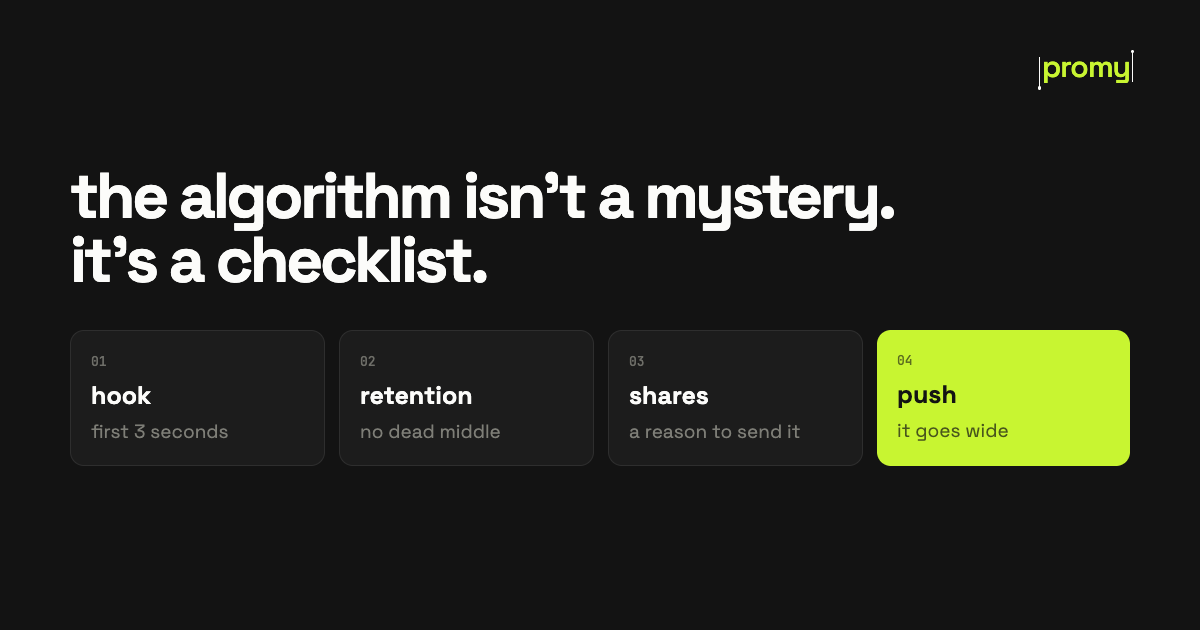
- →TikTok tests every video in waves, watch time decides if it advances
- →Watch time and replays weigh more than likes, comments, or saves
- →The first 1.5 seconds determine whether viewers stay or scroll
- →Structure: hook, context, delivery with beats every 3-5s, strong payoff
TikTok doesn't care how many followers you have. It cares how many seconds people watch.
That's not a motivational quote. It's literally how the algorithm is built. Every video gets tested with a small audience first. If those people keep watching, the algorithm shows it to more people. If they scroll past, the video dies.
Understanding this system is the difference between a video that gets stuck at 200 views and one that reaches 200K. Here's how it actually works, what the algorithm measures at each stage, and the hook formats and video structures that trigger distribution in 2026.
How TikTok's Algorithm Actually Works
Every video you post goes through a batch testing pipeline. It works in waves.
Wave 1 (200-500 views): TikTok shows your video to a small mix of your followers and users whose interests match your content. The algorithm watches one thing above all else: do people keep watching?
If the first 100-200 viewers watch 65%+ of the video on average, TikTok reads that as a strong signal. The video moves to wave 2.
If average watch time drops below 20-30%, distribution stalls after wave 1. This is the "200-view jail" that creators talk about. Your video didn't fail because of timing, hashtags, or bad luck. It failed because the first batch scrolled past it.
Wave 2 (1K-10K views): The video gets pushed to a wider audience with similar interests. TikTok now looks at a broader set of signals: watch time, completion rate, shares, saves, comments, and replays. If engagement stays strong relative to the expanding audience, the video moves to wave 3.
Wave 3 (10K-100K+ views): Distribution expands beyond your core niche into broader interest categories. At this stage, the content needs to hold the attention of people who don't know you and may not be deeply into your topic. Videos that survive wave 3 are the ones that reach 100K, 500K, or millions.
Plateau: Eventually, the algorithm exhausts the relevant audience segments or engagement rates decline. Distribution slows. This is natural and happens to every video, including viral ones.
The Signal Hierarchy: What the Algorithm Weighs Most
Not all engagement signals are equal. Here's the actual priority order based on 2026 data.
1. Watch time and completion rate (dominant signal)
Watch time weighs roughly 2x more than any other metric. A video with 60% average watch time and low comments will still distribute well. A video with 20% average watch time and high comments will get limited distribution. The algorithm treats low watch time as the dominant negative signal, and no amount of likes or comments overrides it.
| Video Length | Target Avg. Watch Time |
|---|---|
| Under 15 seconds | 100%+ (loop watches) |
| 15-30 seconds | 70%+ |
| 30-60 seconds | 50%+ |
| Over 60 seconds | 40%+ |
In 2026, TikTok also tracks "Qualified Views," which means a viewer must watch at least 5 seconds for it to count as a quality view. Your hook needs to hold people past that 5-second mark, not just the first 1-2 seconds.
2. Replays
Replays are the strongest single-event signal the algorithm receives. When someone watches your video twice, it tells TikTok the content was compelling enough to warrant a second viewing. Videos with a replay rate above 1.2 (total plays divided by unique viewers) see substantially stronger distribution.
Content that triggers replays: surprising endings, satisfying loops, information-dense videos where viewers catch new details on second watch, and "wait, what?" moments that make people rewatch the key section.
3. Shares
Shares are the strongest engagement signal because they indicate your content is worth sending to someone else. The algorithm treats shares as a higher-value action than likes, comments, or saves. A video with 500 views and 50 shares will often outperform a video with 5,000 views and 10 shares.
4. Saves
Saves signal "I want to come back to this," which TikTok interprets as high content value. Tutorials, how-to content, lists, and reference material generate the highest save rates.
5. Comments
Comments matter, but less than most creators think. Quality matters more than quantity. A comment that sparks a thread (replies, debate, questions) weighs more than 50 "🔥" comments. The algorithm can distinguish between genuine discussion and surface-level engagement.
6. Likes
The lowest-weighted positive signal. Likes are passive. Most viewers who like a video barely remember doing it. Don't optimize for likes. Optimize for watch time, replays, and shares, and the likes will follow.
The Hook: Your First 1.5 Seconds Decide Everything
If watch time is the dominant algorithm signal, and watch time starts the moment someone sees your video, then the first 1.5 seconds are the most valuable real estate in your content.
TikTok users make a stay-or-scroll decision almost instantly. Your hook needs to create enough curiosity, tension, or visual interest that scrolling feels like a worse option than watching.
Here are the hook formats that consistently trigger high retention in 2026.
The curiosity gap
Open with a statement that creates an unanswered question in the viewer's mind.
- →"I tested 50 different hooks and only 3 actually worked."
- →"There's one thing every viral TikTok has in common."
- →"Nobody talks about this part of [topic]."
Why it works: the brain needs closure. An open question creates a small tension that can only be resolved by watching. The viewer's thumb stops because their curiosity is stronger than the scroll impulse.
The pattern interrupt
Start with something visually or audibly unexpected. A sudden movement. A weird object in frame. A sentence that doesn't make immediate sense.
- →Jump cut to an extreme close-up
- →Open mid-sentence, as if the video already started
- →Start with a contradictory statement: "Don't ever do [the thing everyone does]."
Why it works: TikTok's feed is a stream of sameness. Anything that breaks the visual or auditory pattern forces the brain to pay attention for a moment. That moment is enough to get past the scroll decision.
The "this is for you" direct address
Call out a specific person or situation that makes the viewer feel personally targeted.
- →"If you're still doing [common thing], stop."
- →"POV: you just realized [relatable situation]."
- →"This is for everyone who [specific frustration]."
Why it works: personal relevance. The moment someone thinks "this is about me," they're invested. It transforms the video from generic content into something that feels directed at them.
The result-first hook
Show the end result in the first frame, then explain how you got there.
- →Start with the finished dish, then rewind to the ingredients
- →Show the transformation, then cut to the "before"
- →Display the number or result ("$1,250 from one TikTok"), then explain the process
Why it works: the outcome creates a new question: "how?" The viewer stays to learn the process because you've already proven it's worth learning.
The controversial take
Open with a statement that challenges a commonly held belief in your niche.
- →"Everyone says [popular advice] but it's actually wrong."
- →"I'm going to get hate for this, but [honest opinion]."
- →"The thing about [topic] that experts won't tell you."
Why it works: disagreement activates emotional engagement. The viewer stays either to validate their own belief or to hear you out. Both outcomes drive retention and comments.
The Video Structure That Triggers Distribution
A good hook gets people to stay. A good structure gets them to watch until the end. Completion rate is its own algorithm signal, separate from average watch time. TikTok interprets high completion as "this content delivered on its promise."
The structure that works:
Seconds 0-2: Hook. One of the formats above. No intro, no "hey guys," no logo animation. Start with the hook. Immediately.
Seconds 2-8: Context. Quickly establish what this video is about and why it matters. This is where you set the expectation. "I ran 30 influencer campaigns this year. Here's what I learned" gives the viewer a reason to stay for the next 20 seconds.
Seconds 8-25: Delivery. The core content. Keep it moving. Each new point or beat should arrive every 3-5 seconds. If the viewer's attention has nothing new to latch onto for more than 5 seconds, they'll scroll. Use visual changes (cuts, text overlays, angle changes) to maintain pacing.
Final 3-5 seconds: Payoff. Deliver the promise from your hook. If you opened with "I tested 50 hooks and only 3 worked," this is where you reveal the third one. End on the strongest point, not a trailing "anyway, hope that was helpful." A strong payoff drives completion rate AND replays, because some viewers will loop back to catch what they missed.
Optional loop point: If your video ending flows naturally into the beginning (visually or thematically), viewers will loop-watch without realizing it. This pushes average watch time above 100% for short videos, which is the strongest possible retention signal.
What Kills Videos: The 5 Retention Killers
Even with a strong hook, these things tank watch time.
1. Slow first 5 seconds. Intros, greetings, context-setting before the hook. Every second before the hook is a second where viewers are leaving. A video that starts with "Hey everyone, so today I wanted to talk about something that I've been thinking about lately..." has already lost 40% of its audience before the topic is even mentioned.
2. One-pace delivery. If your video runs at the same speed and energy throughout, viewer attention gradually decays. Vary your pacing. Speed up for lists, slow down for emphasis, use jump cuts to create rhythm. Monotone delivery (vocal or visual) is the silent killer of TikTok content.
3. No visual changes. A talking head with no cuts, no text overlays, no angle changes, and no b-roll for 30 seconds straight is fighting against the platform's entire design. TikTok is built for stimulation. You don't need Hollywood production, but you need visual movement every 3-5 seconds.
4. Promise without payoff. If your hook creates a curiosity gap but your video doesn't deliver, viewers leave before the end. Worse, they feel cheated and won't watch your next video. Your completion rate drops, and the algorithm remembers. Always deliver on what the hook promises, and deliver it before the viewer gets impatient.
5. Weak endings. "Anyway, that's it, follow for more" is the lowest-energy ending possible. It signals that even you think the content is over. End on your strongest point. Or end with a question that drives comments. Or end with a visual that loops into the beginning. The last 3 seconds determine whether someone replays, comments, or scrolls to the next video.
The Cheat Sheet
Print this. Tape it next to your camera.
| Element | Target |
|---|---|
| Hook | First 1.5 seconds, curiosity or pattern interrupt |
| 5-second qualified view | Hold past 5 seconds or TikTok doesn't count it as quality |
| Average watch time | 70%+ for sub-30s, 50%+ for 30-60s, 40%+ for 60s+ |
| Completion rate | As high as possible, its own signal separate from watch time |
| Replay rate | Above 1.2x is excellent, design for "wait, what?" moments |
| Visual pacing | New beat or cut every 3-5 seconds |
| Ending | Strongest point last, or loop into beginning |
| Shares | More valuable than likes, make content people want to send to someone |
The algorithm isn't random and it isn't unfair. It's a system that amplifies content people want to watch. Learn how it measures "want to watch" and build your content around those signals. The views follow.